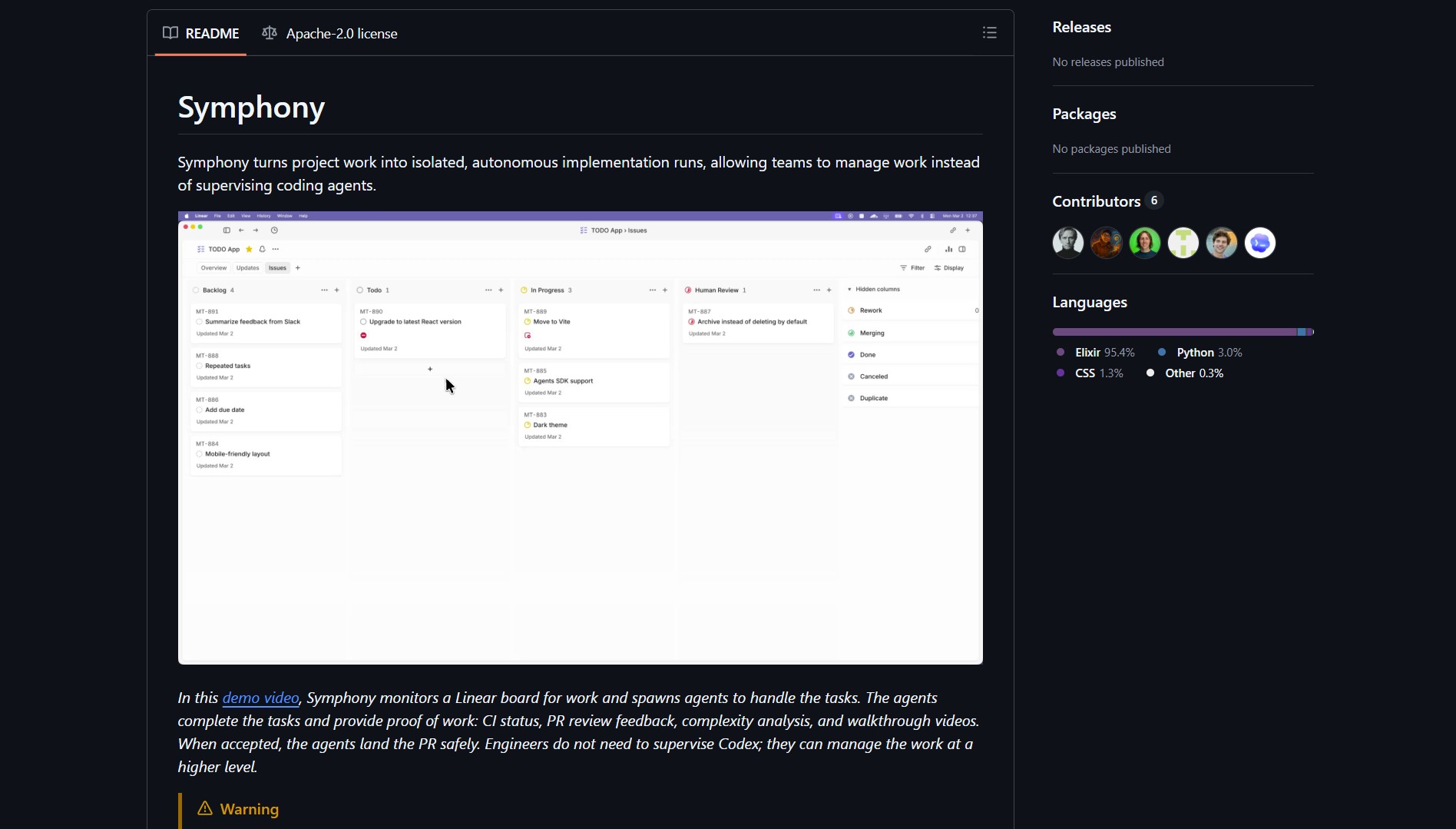
Symphony is an orchestration layer from OpenAI that automates the ticket-to-PR lifecycle. It watches issue trackers like Linear, spawns isolated workspaces for new tickets, and assigns autonomous agents to implement features end to end. The goal is to remove the human middleman from routine engineering workflows.
symphony repo
Symphony hooks into Linear and other trackers to detect new tickets in real time. It creates ephemeral environments so each task runs in isolation. The agent writes code, runs tests, opens PRs, responds to review feedback, and generates a walkthrough video. This is similar to how you can use Cline as an AI coding assistant for targeted code generation, but Symphony owns the full lifecycle from ticket to merge.
Symphony combines four core components. The monitor watches for new tickets. The workspace manager spins up isolated environments. The autonomous agent implements features, runs test suites, and files PRs. The CI integrator gates merges until all checks pass. You can pair Symphony with a self-hosted offline AI platform for teams that need stricter data control over their agent infrastructure.
Threads user, in response to How to Automate the Ticket-to-PR Cycle with Symphony
Start with a restricted pilot on small repos and noncritical branches. Set explicit rollback policies before scaling. Measure flakiness, test coverage, and PR quality to decide whether the agent pipeline is ready for production use. You can also look at Career-Ops for another example of agent-driven workflow automation applied to job searching.
The Catch
Symphony changes the human role from implementer to reviewer and manager of agent behavior. Autonomous development agents carry safety, security, and compliance risks. Run experiments in isolated labs and require human approval for production merges. Keep strong observability, audit logs, and a clear rollback strategy. The practical limit is trust in agent output, so validate everything before landing.
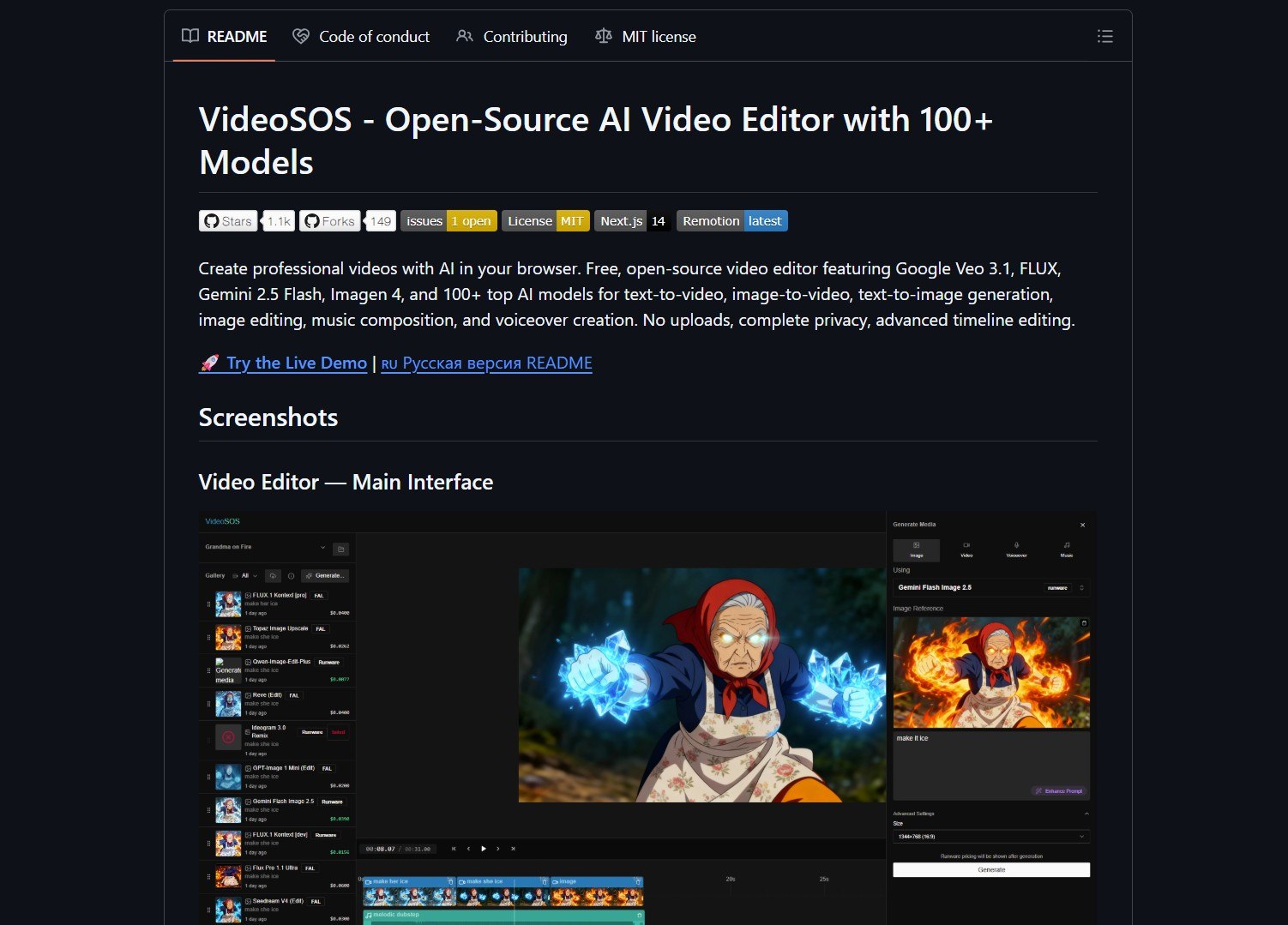
VideoSOS is an open-source, browser-first video editor that brings over 100 AI models into your browser. It handles text-to-video, image-to-video, image editing, music composition, and voiceover creation without uploading media to the cloud. The repo bundles integrations with fal.ai and Runware.ai and supports models like Google Veo 3.1, Gemini 2.5 Flash, and Imagen 4.
videosos repo
The stated goal is zero uploads and complete privacy by running as much as possible in the client or via local runtimes. You can generate short clips from prompts, edit frames, create voiceovers, and assemble multi-track projects on a standard timeline. This makes it a strong option for privacy-conscious content creation and rapid video prototyping.
Key Features
VideoSOS offers broad model coverage for video, image, and audio tasks. Its timeline editor supports standard NLE workflows for assembling and polishing multi-track projects. The local-first promise means no uploads, subject to which models actually run on your hardware.
It supports text-to-video and image-to-video generation, image editing, text-to-speech with multiple synthesis engines, and music composition. You can also build and scale AI agents for broader automation workflows using a self-hosted offline AI platform alongside your media tools.
VideoSOS wires together model runtimes, a web UI timeline editor, and integration adapters to switch providers. Where local runtimes are not possible, the project provides provider adapters for fal.ai and Runware.ai so generation can still happen without user-managed servers. This is similar to how you can route 1600 AI models with a unified gateway for flexible provider switching.
Threads user, in response to How to Use VideoSOS for Browser Video Editing with 100+ AI Models
Start with a single generation pipeline on a local machine with known GPU or CPU capability before attempting a full 100-model experiment. The quick start is straightforward: clone the repo, install local runtimes or configure provider adapters, and test a text-to-image-to-video pipeline.
The Catch
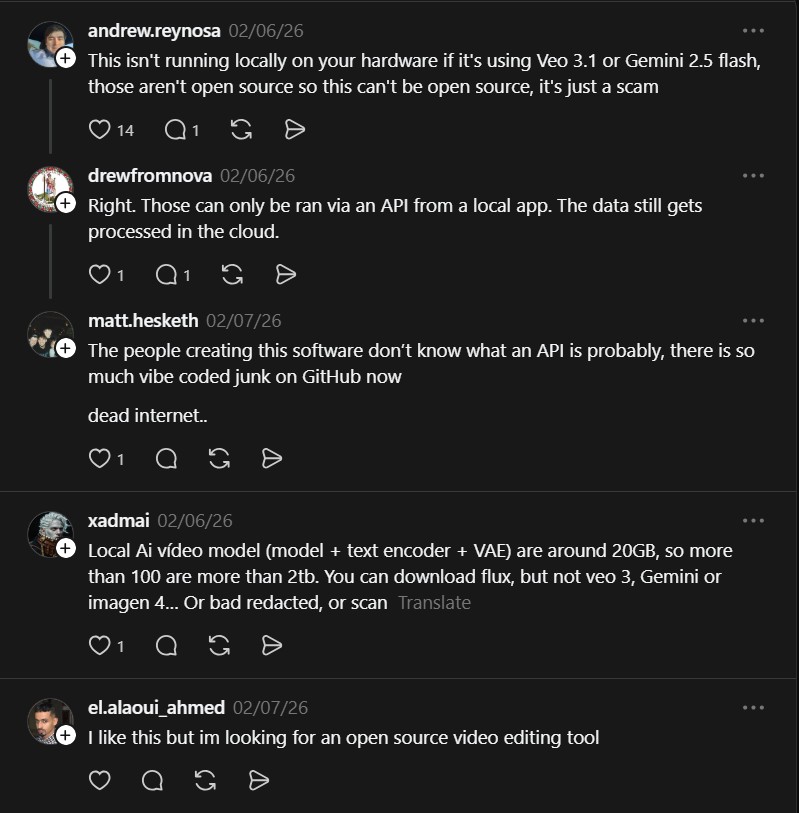
Claims about running proprietary models locally should be validated. Many named models like Gemini and Imagen are not fully open-source or available for local execution without licensing. Large model claims are resource intensive and sometimes conflate remote provider integrations with true local execution. Verify which models the repo runs locally and respect licensing for proprietary models. Evaluate GPU or VRAM requirements and disk capacity before experimenting.
VideoSOS is compelling as a distribution idea: a browser editor that unifies many media models under a single timeline workflow. The practical limits are hardware and model licensing, so validate runtimes and start with a constrained pilot.
VideoSOS is an open-source, browser-first video editor that brings over 100 AI models into your browser. It handles text-to-video, image-to-video, image editing, music composition, and voiceover creation without uploading media to the cloud. The repo bundles integrations with fal.ai and Runware.ai and supports models like Google Veo 3.1, Gemini 2.5 Flash, and Imagen 4.
videosos repo
The stated goal is zero uploads and complete privacy by running as much as possible in the client or via local runtimes. You can generate short clips from prompts, edit frames, create voiceovers, and assemble multi-track projects on a standard timeline. This makes it a strong option for privacy-conscious content creation and rapid video prototyping.
Key Features
VideoSOS offers broad model coverage for video, image, and audio tasks. Its timeline editor supports standard NLE workflows for assembling and polishing multi-track projects. The local-first promise means no uploads, subject to which models actually run on your hardware.
It supports text-to-video and image-to-video generation, image editing, text-to-speech with multiple synthesis engines, and music composition. You can also build and scale AI agents for broader automation workflows using a self-hosted offline AI platform alongside your media tools.
VideoSOS wires together model runtimes, a web UI timeline editor, and integration adapters to switch providers. Where local runtimes are not possible, the project provides provider adapters for fal.ai and Runware.ai so generation can still happen without user-managed servers. This is similar to how you can route 1600 AI models with a unified gateway for flexible provider switching.
Threads user, in response to How to Use VideoSOS for Browser Video Editing with 100+ AI Models
Start with a single generation pipeline on a local machine with known GPU or CPU capability before attempting a full 100-model experiment. The quick start is straightforward: clone the repo, install local runtimes or configure provider adapters, and test a text-to-image-to-video pipeline.
The Catch
Claims about running proprietary models locally should be validated. Many named models like Gemini and Imagen are not fully open-source or available for local execution without licensing. Large model claims are resource intensive and sometimes conflate remote provider integrations with true local execution. Verify which models the repo runs locally and respect licensing for proprietary models. Evaluate GPU or VRAM requirements and disk capacity before experimenting.
VideoSOS is compelling as a distribution idea: a browser editor that unifies many media models under a single timeline workflow. The practical limits are hardware and model licensing, so validate runtimes and start with a constrained pilot.
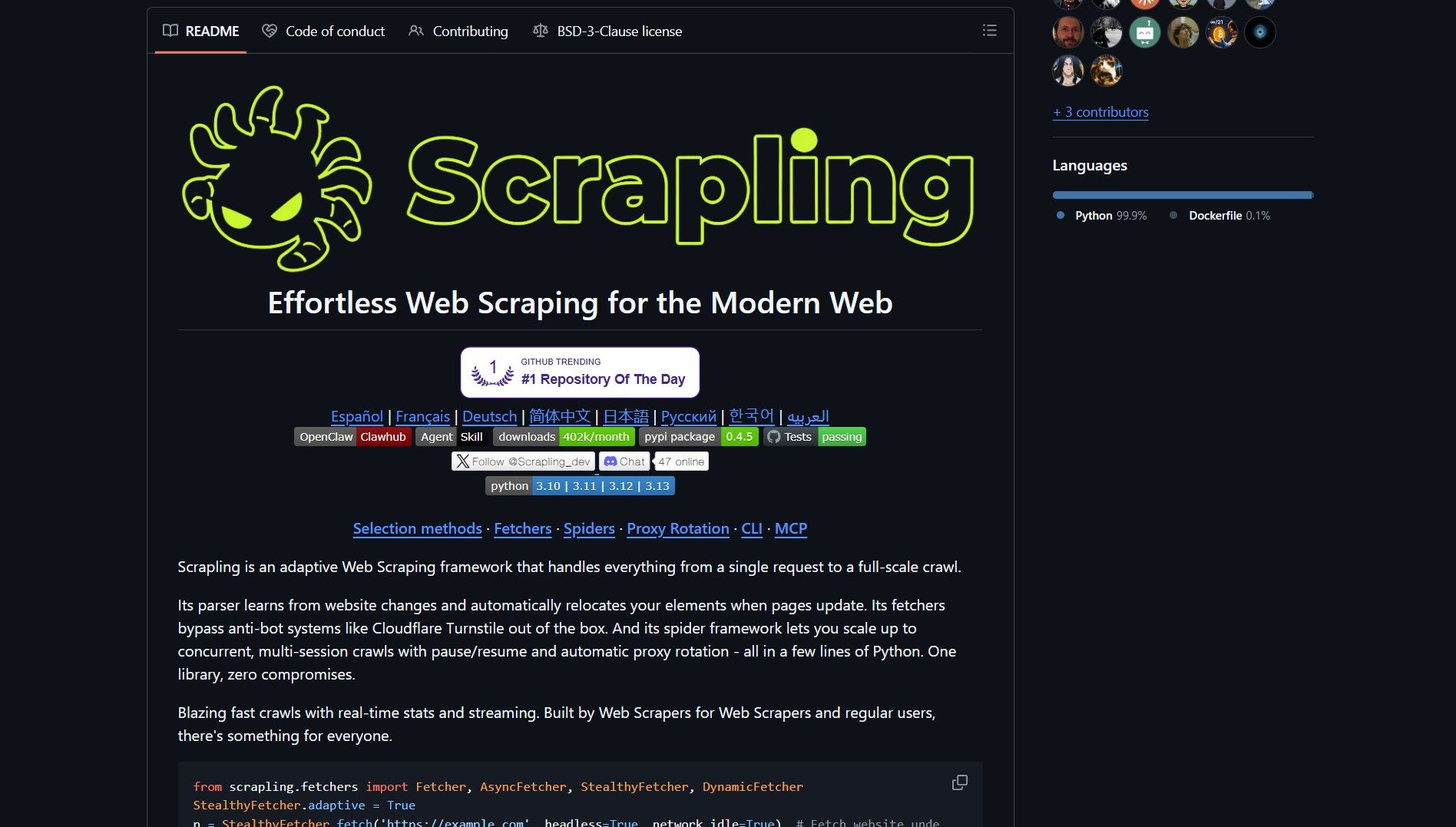
Scrapling is an open-source web scraping framework by D4Vinci that bypasses Cloudflare protections natively. The adaptive parser relocates selectors when pages change, reducing maintenance. It supports proxy rotation, pause and resume, and concurrent multi-session crawls.
scrapling repo
The fetchers include anti-bot techniques that remove the need for separate scraping stacks. The parser runs up to 774x faster than BeautifulSoup for some workloads. Developers can integrate Scrapling into agentic pipelines, similar to how Gobii runs durable autonomous agents in production environments.
How It Works
Scrapling uses an adaptive parser that learns from layout changes. When a target site updates its HTML structure, the parser relocates elements automatically. The anti-bot fetchers handle Cloudflare Turnstile and other protections without manual configuration.
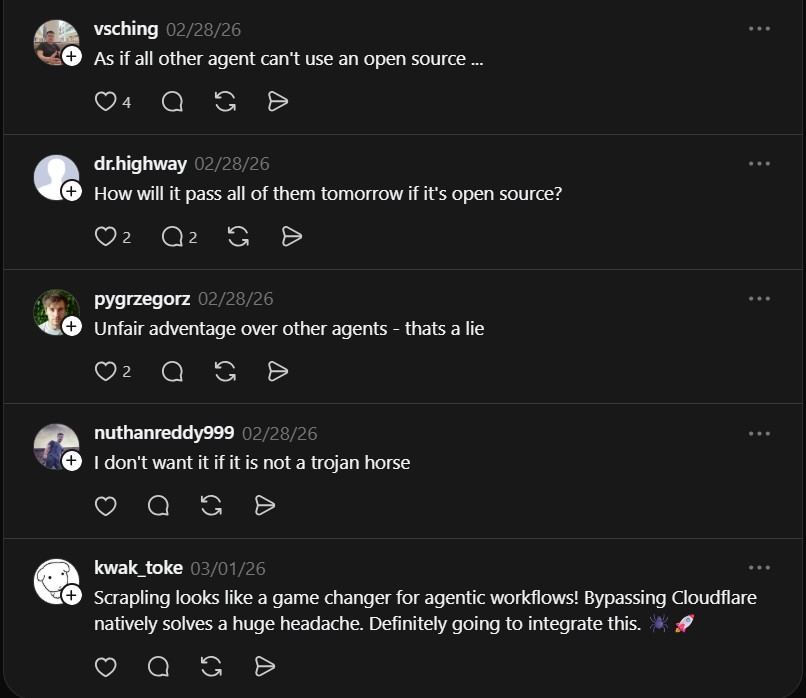
Threads user, in response to How to Bypass Cloudflare with Scrapling
For large-scale crawls, the spider framework manages concurrent sessions with automatic proxy rotation. It supports pause and resume, so interrupted crawls do not restart from scratch. To get started, run git clone https://github.com/D4Vinci/Scrapling and follow the repo instructions to configure fetchers and parser.
Use Cases
SaaS agents use Scrapling to pull site data without rebuilding frontends after layout changes. Data engineering pipelines run large-scale crawls with pause and resume for reliability. Developers building full-stack AI solutions with LangChain and LangGraph can add Scrapling as a data ingestion layer.
Claims about bypassing protections are sensitive. Evaluate legal and ethical considerations before deploying at scale. Validate the parser on your target sites and measure throughput first. Start with a small pilot on low-traffic targets before scaling with proxy settings.
Scrapling is an open-source web scraping framework by D4Vinci that bypasses Cloudflare protections natively. The adaptive parser relocates selectors when pages change, reducing maintenance. It supports proxy rotation, pause and resume, and concurrent multi-session crawls.
scrapling repo
The fetchers include anti-bot techniques that remove the need for separate scraping stacks. The parser runs up to 774x faster than BeautifulSoup for some workloads. Developers can integrate Scrapling into agentic pipelines, similar to how Gobii runs durable autonomous agents in production environments.
How It Works
Scrapling uses an adaptive parser that learns from layout changes. When a target site updates its HTML structure, the parser relocates elements automatically. The anti-bot fetchers handle Cloudflare Turnstile and other protections without manual configuration.
Threads user, in response to How to Bypass Cloudflare with Scrapling
For large-scale crawls, the spider framework manages concurrent sessions with automatic proxy rotation. It supports pause and resume, so interrupted crawls do not restart from scratch. To get started, run git clone https://github.com/D4Vinci/Scrapling and follow the repo instructions to configure fetchers and parser.
Use Cases
SaaS agents use Scrapling to pull site data without rebuilding frontends after layout changes. Data engineering pipelines run large-scale crawls with pause and resume for reliability. Developers building full-stack AI solutions with LangChain and LangGraph can add Scrapling as a data ingestion layer.
Claims about bypassing protections are sensitive. Evaluate legal and ethical considerations before deploying at scale. Validate the parser on your target sites and measure throughput first. Start with a small pilot on low-traffic targets before scaling with proxy settings.
Scrapling is an open-source web scraping framework by D4Vinci that bypasses Cloudflare protections natively. The adaptive parser relocates selectors when pages change, reducing maintenance. It supports proxy rotation, pause and resume, and concurrent multi-session crawls.
scrapling repo
The fetchers include anti-bot techniques that remove the need for separate scraping stacks. The parser runs up to 774x faster than BeautifulSoup for some workloads. Developers can integrate Scrapling into agentic pipelines, similar to how Gobii runs durable autonomous agents in production environments.
How It Works
Scrapling uses an adaptive parser that learns from layout changes. When a target site updates its HTML structure, the parser relocates elements automatically. The anti-bot fetchers handle Cloudflare Turnstile and other protections without manual configuration.
Threads user, in response to How to Bypass Cloudflare with Scrapling
For large-scale crawls, the spider framework manages concurrent sessions with automatic proxy rotation. It supports pause and resume, so interrupted crawls do not restart from scratch. To get started, run git clone https://github.com/D4Vinci/Scrapling and follow the repo instructions to configure fetchers and parser.
Use Cases
SaaS agents use Scrapling to pull site data without rebuilding frontends after layout changes. Data engineering pipelines run large-scale crawls with pause and resume for reliability. Developers building full-stack AI solutions with LangChain and LangGraph can add Scrapling as a data ingestion layer.
Claims about bypassing protections are sensitive. Evaluate legal and ethical considerations before deploying at scale. Validate the parser on your target sites and measure throughput first. Start with a small pilot on low-traffic targets before scaling with proxy settings.
Scrapling is an open-source web scraping framework by D4Vinci that bypasses Cloudflare protections natively. The adaptive parser relocates selectors when pages change, reducing maintenance. It supports proxy rotation, pause and resume, and concurrent multi-session crawls.
scrapling repo
The fetchers include anti-bot techniques that remove the need for separate scraping stacks. The parser runs up to 774x faster than BeautifulSoup for some workloads. Developers can integrate Scrapling into agentic pipelines, similar to how Gobii runs durable autonomous agents in production environments.
How It Works
Scrapling uses an adaptive parser that learns from layout changes. When a target site updates its HTML structure, the parser relocates elements automatically. The anti-bot fetchers handle Cloudflare Turnstile and other protections without manual configuration.
Threads user, in response to How to Bypass Cloudflare with Scrapling
For large-scale crawls, the spider framework manages concurrent sessions with automatic proxy rotation. It supports pause and resume, so interrupted crawls do not restart from scratch. To get started, run git clone https://github.com/D4Vinci/Scrapling and follow the repo instructions to configure fetchers and parser.
Use Cases
SaaS agents use Scrapling to pull site data without rebuilding frontends after layout changes. Data engineering pipelines run large-scale crawls with pause and resume for reliability. Developers building full-stack AI solutions with LangChain and LangGraph can add Scrapling as a data ingestion layer.
Claims about bypassing protections are sensitive. Evaluate legal and ethical considerations before deploying at scale. Validate the parser on your target sites and measure throughput first. Start with a small pilot on low-traffic targets before scaling with proxy settings.
Symphony is an orchestration layer for autonomous engineering runs. It hooks into Linear, spawns isolated workspaces, and assigns an AI agent to implement a ticket end to end. The agent writes code, runs tests, opens PRs, responds to reviews, and lands the change when CI passes.
symphony repo
What Symphony does
Symphony automates the full ticket-to-PR lifecycle. It monitors issue trackers for new tickets and creates ephemeral workspaces for each one. An autonomous agent gets the task context and test harness, then implements features, runs tests, and files pull requests.
The agent also handles review feedback and updates the PR until CI passes. Symphony can generate a walkthrough video before landing the change. This shifts the developer role from implementer to reviewer.
Symphony combines event triggers, ephemeral environments, and autonomous agents. The monitor watches Linear for new tickets. When a ticket appears, the workspace manager creates an isolated environment. The agent receives the task context and test harness.
Threads user, in response to How to Automate the Ticket-to-PR Cycle with Symphony
The agent then implements the feature, runs tests, and opens a pull request. It responds to review feedback and updates the PR until tests pass. When CI succeeds, the change lands automatically.
The catch
Autonomous development agents carry safety and security risks. Symphony should run in isolated labs with human approvals for production merges. Start with small repos, noncritical branches, and explicit rollback policies. Measure flakiness, test coverage, and PR quality before scaling.
Symphony is an orchestration layer for autonomous engineering runs. It hooks into Linear, spawns isolated workspaces, and assigns an AI agent to implement a ticket end to end. The agent writes code, runs tests, opens PRs, responds to reviews, and lands the change when CI passes.
symphony repo
What Symphony does
Symphony automates the full ticket-to-PR lifecycle. It monitors issue trackers for new tickets and creates ephemeral workspaces for each one. An autonomous agent gets the task context and test harness, then implements features, runs tests, and files pull requests.
The agent also handles review feedback and updates the PR until CI passes. Symphony can generate a walkthrough video before landing the change. This shifts the developer role from implementer to reviewer.
Symphony combines event triggers, ephemeral environments, and autonomous agents. The monitor watches Linear for new tickets. When a ticket appears, the workspace manager creates an isolated environment. The agent receives the task context and test harness.
Threads user, in response to How to Automate the Ticket-to-PR Cycle with Symphony
The agent then implements the feature, runs tests, and opens a pull request. It responds to review feedback and updates the PR until tests pass. When CI succeeds, the change lands automatically.
The catch
Autonomous development agents carry safety and security risks. Symphony should run in isolated labs with human approvals for production merges. Start with small repos, noncritical branches, and explicit rollback policies. Measure flakiness, test coverage, and PR quality before scaling.
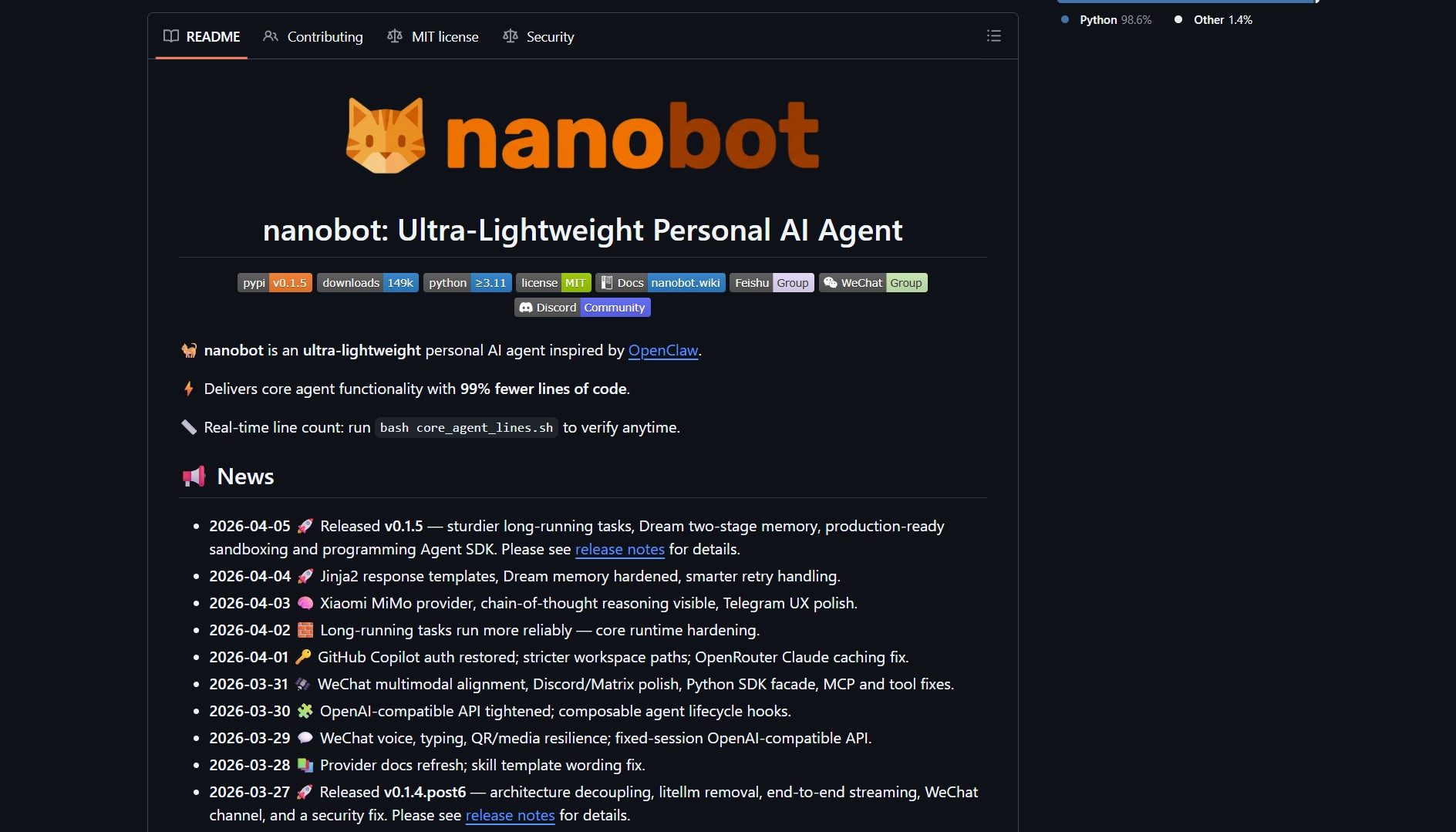
I ran into this repo on GitHub and had to stop, because Nanobot is an ultra-light clawdbot-style assistant that boots in under a minute. Where Clawdbot requires 430,000 plus lines of code to run, Nanobot delivers the same core agent loop in roughly 4,000 lines — a dramatic reduction in complexity and surface area.
What is Nanobot?
Nanobot is a minimal, research-friendly agent framework from HKUDS that focuses on readability, speed, and low resource usage. The repository demonstrates a compact core agent loop, real-time tooling to count lines (core_agent_lines.sh), and ergonomics that make the codebase approachable for researchers and engineers who want to build personal AI agents without framework bloat.
nanobot repo
Note: Line count comparisons are indicative, not a full measure of capability. A smaller codebase reduces maintenance overhead and attack surface, but you should validate features and stability for your use case.
Customer Persona
The typical Nanobot user is a machine learning researcher or software engineer who needs a lightweight, inspectable agent framework for prototyping AI behaviors. They value code readability, fast iteration cycles, and minimal dependencies over production-ready safety features. This persona often works in academic or R&D environments where they need to experiment with agent loops without the overhead of larger frameworks like LangChain or AutoGPT.
Market Analysis
Nanobot enters a crowded market of AI agent frameworks, competing with heavyweights like LangChain, AutoGPT, and Clawdbot. Its differentiation lies in its extreme minimalism—4,000 lines versus 430,000—making it uniquely suited for research and educational use. While it lacks the battle-tested robustness and ecosystem of larger frameworks, its small size allows for full auditability and customization, similar to the approach used by the OpenHands development platform for building and scaling AI agents. For production deployments, teams would likely still choose more mature options, but Nanobot fills a niche for rapid prototyping and agent architecture studies.
Key Features
Ultra-Lightweight — small codebase that starts fast and is easy to inspect
Research-Ready — readable structure makes experimentation straightforward
Lightning Fast Startup — no massive dependency load, quick iterations
One-Click Deploy — minimal setup to get the agent loop running
Threads user, in response to How to Use Nanobot as an Ultra-Light Personal AI Agent
How It Works
At a high level, Nanobot implements the standard agent loop with tight, explicit components and a small set of adapters for tools and IO. The project emphasizes compact state encodings and a minimal runtime so you can reason about behavior in a single afternoon.
git clone https://github.com/HKUDS/nanobot

cd nanobot

# inspect line count and core scripts

bash core_agent_lines.sh

# run the agent as documented in the README
Component
Purpose
Core loop
The minimal event/task loop that drives agent decisions
Adapters
Lightweight connectors for tools, IO, and external APIs
Utilities
Helper scripts, including the line counting tool
Tests / Examples
Small demos to exercise typical agent flows
Tip: Run bash core_agent_lines.sh to verify the real-time line count, and use the small demos to understand the agent’s action model before extending it.
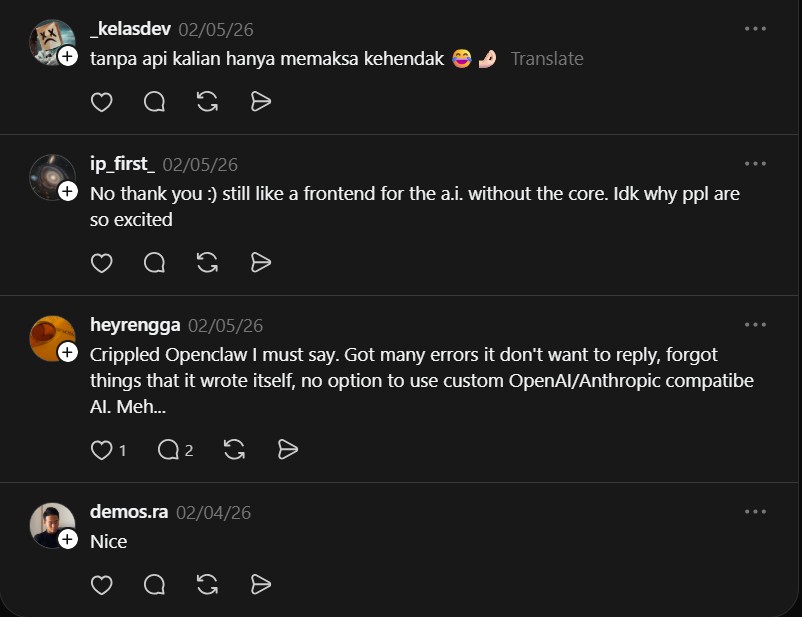
Community Reactions
“No thank you 🙂 still like a frontend for the a.i. without the core. Idk why ppl are so excited” — @ip_first_
“Crippled Openclaw I must say. Got many errors it don’t want to reply, forgot things that it wrote itself, no option to use custom OpenAI/Anthropic compatibe AI. Meh…” — @heyrengga
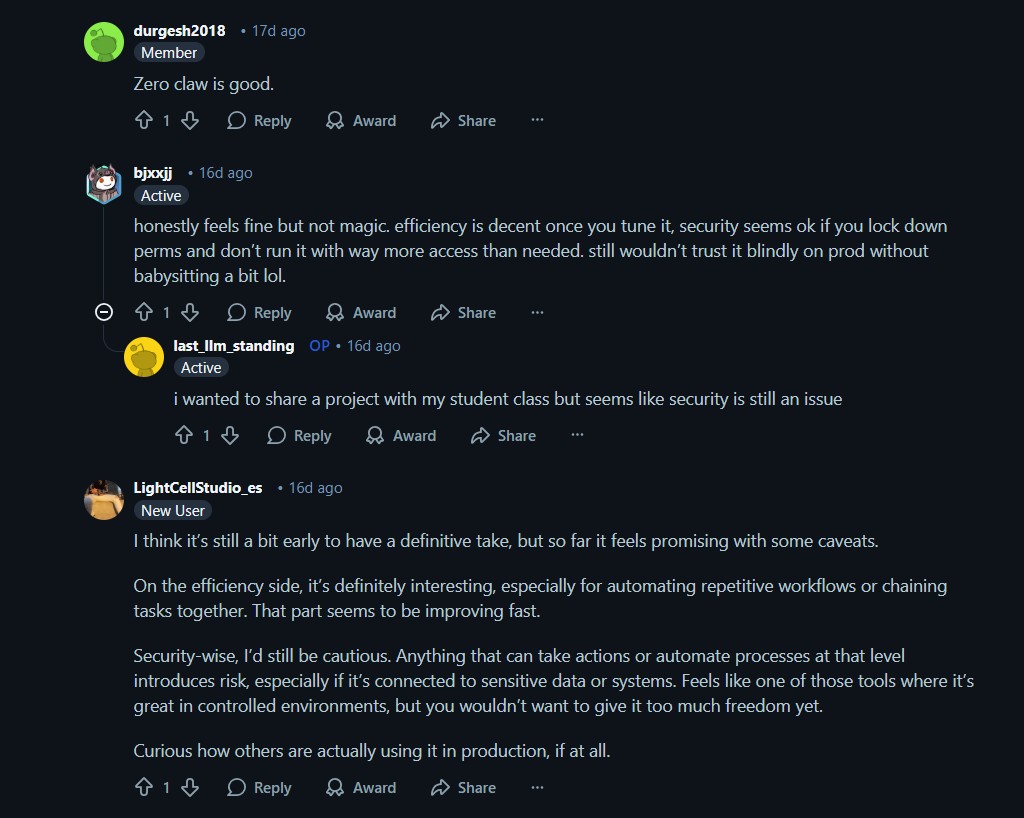
“honestly feels fine but not magic. efficiency is decent once you tune it, security seems ok if you lock down perms and don’t run it with way more access than needed. still wouldn’t trust it blindly on prod without babysitting a bit lol.” — u/bjxxjj
“I think it’s still a bit early to have a definitive take, but so far it feels promising with some caveats…” — u/LightCellStudio_es
Warning: Minimal frameworks lower complexity, but they may omit hardened defaults or safety guards you expect in larger stacks. Do not run on sensitive systems without appropriate sandboxing and access controls.
Final Thoughts
What caught my attention is the engineering tradeoff: by shrinking the codebase you gain inspectability and speed, which is great for research and prototyping. If you adopt Nanobot for anything beyond experimentation, build a safety layer, add monitoring, and validate behavior under representative workloads.